
How Unnoticed Habits Are Formed: The Behaviours You Don’t Realise You Repeat
Most of us think our day is run by decisions, but a surprising amount of it is run by repetition. Unnoticed habits are the ones that feel like “just how I am”: the snack you reach for while the kettle boils, the way you pick up your phone at red lights, the tone you use when you’re tired. They rarely start as a deliberate choice, yet over time they become the default setting.
The hidden mechanics behind habits you barely notice
Habits form because the brain is built to save effort. When a situation repeats—same time, same place, same emotional state—the brain starts predicting what usually happens next and prepares the “next step” automatically. This is efficient, but it also means your behaviour can become less about intention and more about pattern matching.
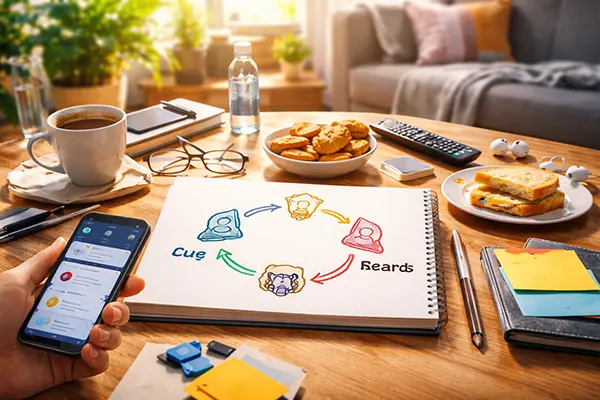
A useful way to understand this is the habit loop: cue, response, reward. The cue is a trigger (a notification sound, finishing a meeting, a dip in energy). The response is the behaviour (scrolling, making tea, checking the fridge). The reward is what makes it stick, and it’s often subtle: a hit of relief, a tiny sense of control, a moment of stimulation, or simply a break from boredom.
Unnoticed habits are usually “low-drama” habits. They don’t feel like a big decision, so you don’t log them mentally. That’s why people can swear they “rarely” do something, while their screen-time report, spending history, or snack cupboard tells a different story.
Why context beats motivation in real life
In 2026, many people track sleep, steps, and screen time, yet still feel confused about why they keep repeating the same patterns. The missing piece is often context. Your brain links behaviours to environments: the sofa becomes paired with streaming and snacking; the commute becomes paired with scrolling; the kitchen counter becomes paired with grazing.
Motivation is unreliable because it fluctuates with stress, sleep, workload, and mood. Context is reliable because it’s sitting there every day, quietly suggesting the same actions. This is why you can feel disciplined at work and then “mysteriously” lose control at home—different cues, different defaults.
If you want to spot an unnoticed habit, look for behaviours that appear in the same setting. Ask: “When does this usually happen?” not “Why am I weak?” That shift turns the problem into something you can map and redesign.
How unnoticed habits start: tiny repeats, quick rewards
Many habits start as a sensible one-off. You check your phone because you’re expecting an important message. You snack because you skipped lunch. You stay up late because you needed quiet time. The brain notices: “That solved something.” If the same situation repeats, the behaviour starts to fire automatically before you’ve even named the need.
Rewards don’t have to be pleasure. Relief is one of the strongest reinforcers. If an action reduces tension—opening social media to avoid an awkward pause, pouring a drink to switch off, reorganising your inbox to feel in control—it can lock in quickly, even if you don’t particularly enjoy it.
Friction matters too. In 2026, habits are often shaped by design choices: one-tap logins, autoplay, endless feeds, delivery apps that remember your “usual,” and home screens set up for speed. Convenience isn’t neutral; it quietly decides what you do when you’re tired.
The role of stress, sleep, and decision fatigue
Unnoticed habits often surge when your brain is running low on fuel. Poor sleep, long stretches of concentration, social pressure, and constant switching between tasks all increase reliance on automatic behaviours. You aren’t “failing”; you’re defaulting to what’s already wired.
Stress narrows attention. Under pressure, the brain prioritises quick comfort and familiar scripts. That’s why the same person who cooks balanced meals on Sunday can order takeaways on Thursday without feeling like it was a real choice.
A practical tell is this: if the behaviour spikes after 3pm, after meetings, after commuting, or after putting children to bed, you’re looking at an energy-management issue as much as a willpower issue. Addressing the trigger often works better than fighting the behaviour head-on.

Making the invisible visible, then reshaping it
The first step is noticing without turning it into a morality play. Pick one routine you want to understand and track it for a week with a simple note: cue (where/when), feeling (tired, bored, tense), behaviour, and what you got out of it. Keep it factual. Patterns show up quickly when you stop relying on memory.
Once you can name the cue and the reward, you can redesign the response. If the reward is a break, you can build a short break that actually restores you. If the reward is stimulation, you can choose a different dose: music, a brief walk, a quick chat, or a task switch with a clear end.
Environment design is usually the fastest lever. Make the unwanted habit slightly harder and the better option slightly easier. Put snacks in a higher cupboard, keep fruit visible, charge your phone outside the bedroom, remove the most distracting apps from the home screen, or set Focus modes for work blocks. Small frictions compound.
Simple experiments that work in a normal week
Use “if–then” planning: “If I finish lunch, then I’ll take a five-minute walk,” or “If I feel the urge to scroll in bed, then I’ll put the phone on the chair and read two pages.” This approach works because it ties your preferred action to a cue you already have, rather than hoping you’ll remember later.
Try substitution, not suppression. If you remove a habit without replacing the reward, your brain will hunt for the old fix. Replace the function: if you snack for comfort, build a comfort ritual; if you scroll for escape, create a short escape that ends cleanly (a timed stretch, a shower, a ten-minute tidy).
Finally, make success measurable in behaviour terms, not identity terms. Instead of “I will be disciplined,” aim for “I will leave my phone outside the bedroom five nights this week.” When the target is concrete, it’s easier to repeat—and repetition is the real engine of change.